There are some ways to reduce cost of a mattress. They are often applied by some manufacturers who strive for a quick profit despite the fact that they cause finally deterioration of mattress properties.
The first way: Changing of spring block construction.
A vast majority of spring mattresses are made on the basis of biconical spring blocks. Only a special machine assembly can provide a good quality of such blocks.
It is much cheaper to apply a manual assembly instead of a machine one. But manual assembly cannot provide a proper spring fixation. The springs begin to fall out causing squeaking. It's certainly harmful in both physical and esthetic meaning. Unfortunately it's very difficult to detect such defects while buying a mattress.
Application of four turn springs instead of five turn ones allows reducing the block cost by 10 %. But such a mattress won't be as hard as required to provide orthopedic effects. You may detect such a defect paying attention at thickness of the mattress. A high quality mattress should be from 17 to 22 cm thick in ordinary state and not less than 15 cm in a condensed form.
Application of frameless spring block instead of a double frame one allows saving 10 % more. For a check press the mattress edge. It must be hard.
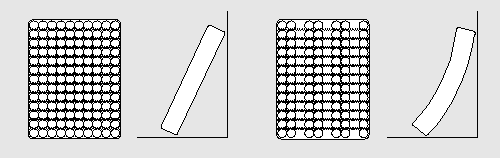
Thinning out. A high quality mattress should have a number of spring rows equal to the width of the ready-made mattress expressed in decimeters. So there must be 16 rows in a 16 dm mattress. There are a lot of manufacturers who reduce significantly the number of rows. For a check press the mattress surface. It should be hard and elastic. Place the mattress on its edge on the floor and lean it against the wall. It must keep its form (figure on the left). If the mattress bends significantly it proves poor quality of the mattress (figure on the right).
The second way: Application of poor quality planking.
Planking means the layers following the shielding material. Planking is usually made of foam rubber, felt, sheet wadding, etc.
Application of low thickness foamed polyurethane (less than 25 kg / m3). It's almost impossible to detect the defect by appearance of the mattress at once. The defect becomes evident about two months later when the foam rubber becomes worn out causing dents in the mattress. For a check try to examine the mattress surface. It must be hard and elastic. Unfortunately it's very difficult to detect this defect, so the best advice to you is not to fall into temptation from mattresses of too low price.
Replacing of foam rubber for sheet wadding reduces significantly the mattress cost. The problem is that this material has no elastic properties. Poor quality of such a mattress becomes evident right from the first month of its usage and you may notice dents and knolls in the mattress. So don't trust advertisements that sheet wadding is much better in ecological meaning and try to examine the mattress surface as carefully as possible.
Some manufacturers have recently begun to use coconut fibers for planking. Natural coconut fibers are very popular and rich for useful properties. But take into consideration that application of natural coconut fibers is extremely expensive. So don't trust if a cheap mattress is advertised as made of natural coconut fibers. In reality it's made of phenolics. These components may cause allergy and bad smell, and are very poor in elastic properties. So don't fall for this bait, and don't trust unreasonable advertisements.
Sometimes felt can be used. It is acceptable but pay great attention at quality of the felt.
Usage of chintz instead of jacquard. Don't be deceived as chintz becomes shabby and frayed in a very short period of time. It can also fall ragged or become electric. Belgian jacquard is mostly suitable to be used for mattresses. It consists of natural fibers (70 %) and synthetics (30 %). For a check you may try to strain and rub the material. The problem is that only a specialist may determine proper quality of the material.
The third way: Sale of non-quilted mattresses.
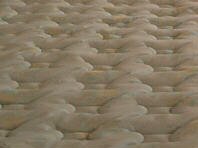
Such mattresses have much shorter lifetime as the covering begins to slip even when you just touch it or loan against it. For a check you may look carefully at the quilting quality. There should be no stitch gaps and the pattern should be rather small (re. photo below).
Another way for manufacturers to get higher profits is to use brand marks names for their production of much lower quality. So while buying a mattress of a well-known company but at lower price we recommend you to clear up some questions:
1. Type of the block that is used in a mattress (whether it is frame or not, the number of springs, the number of spring turns, thickness of the wire used for the springs);
2. The staff used in the mattress (foam rubber, felt, coconut), the manufacturer;
3. Whether glues are applied to assembly;
4. Type of the covering fabric used in the mattress (bonded, silk, jacquard), its structure, the manufacturer;
5. Whether the mattress is quilted or not;
6. Whether the mattress has a removable covering.
Similar pages: